
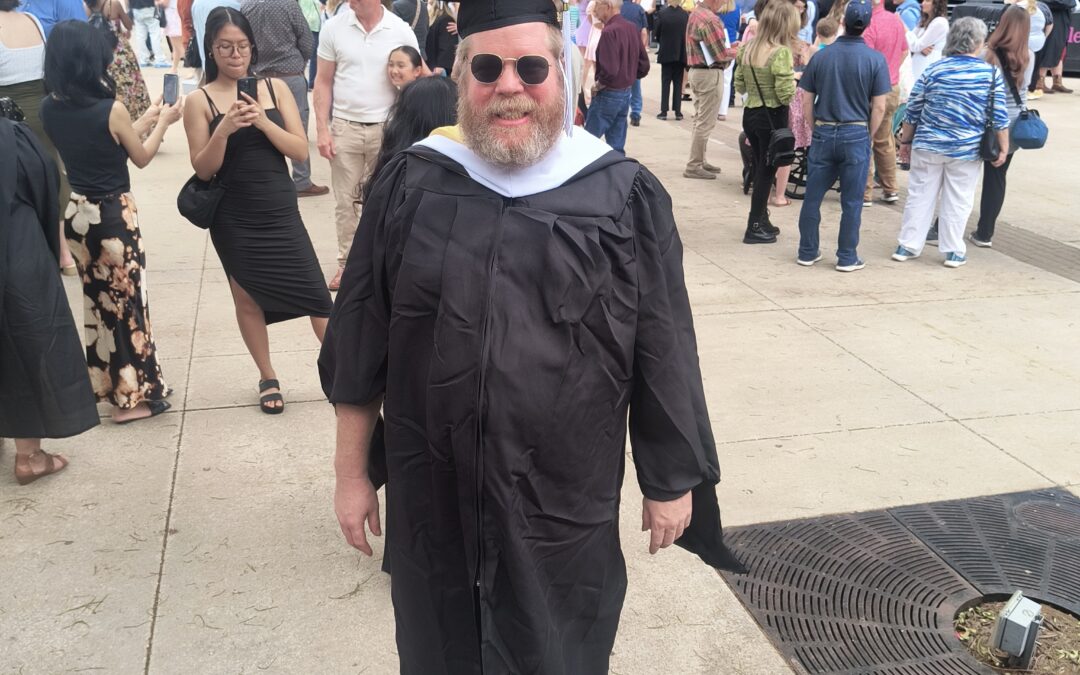
I began my career in Economics at Sacramento State University. My unofficial advisor there was Dr. John Henry; after several frustrating experiences in introductory Economics courses, I decided to attend Sac State, and when I walked into Dr. Henry’s classroom that first regular-semester day, the first thing he taught was, “We all used to be Commies.” And while I ultimately don’t agree with this, it was exactly the heterodox approach that I had been implicitly looking for. Upon completing my undergrad degree, Dr. Henry had just left Sac State to teach at UMKC! Fast forward a decade after living and working in Santa Cruz, CA for 2 years; living and working in China for 7 years, living for half a year in South America and attending Community College studying History and Political Science in China: after this ten years I decided to attend Wright State University in Fairborn, Ohio and earn an MS in Social and Applied Economics.
Imagine my amazement to find that a book assigned for a class was authored by Dr. Henry from way back from Sac State, ten years before. The professor assigning his book had graduated from the (integrated) Economics program at UMKC; I soon became introduced to Modern Monetary Theory (MMT), of which UMKC was the global center for MMT: everybody in the program at this State College in Southwest Ohio in the Advanced Macro class that day had been very excited by it. I had the choice of another very established Heterodox Economics program, yet I chose UMKC because of the freedom to research theoretical economics there, which is a rare opportunity in the United States.
Once at UMKC, my first experience was to have my then future advisor, Dr. Forestater, walk down the hall and into the classroom. I felt an immediate connection with him, and he has become my advisor. It was like a final rising of my first connection with Dr. Henry (who has since passed). Dr. Forstater eventually encouraged my nascent work in climate economics, begun at UMKC. This has resulted in the penultimate paper of my soon-to-be proposed dissertation. Dr. Erik Olson’s Advanced Microeconomics class and its teaching pushed the paper that I have been working on for over twenty years over the hump and into the endgame. It reports a utilitarian theory of exploitation. The MMT teacher, Dr. Fullwiler, introduced me to the horrors of the positive discount rate on future Anthropogenic-Global-Climate-Change (AGCC) Damage, the refutation of which has been—along with my exploitation and initial climate-economics paper—central to my research over the past four years. Dr. Srisha Naidu’s class has fostered further Work, as has the visiting Dr. John Marangos, whose class allowed another paper in my planned dissertation concerning the economics, politics, culture, and relevant management of AGCC in China, where I had again lived for seven years.
My greatest hopes of completing my work in theoretical economics are being fulfilled at UMKC throughout my time here, and as I am in the ABD phase of my PhD, there has been such tacit encouragement of my research at UMKC, supporting it both in spirit and in terms of class content and beyond. Moving away from the academic, I like to hang out at Einstein Bagels on campus because of the warm energy there, and some of the cultural activities have been amazing. It is so nice to be able to get essentially any external research that I need at the library. Furthermore, I had earned the credit for the interdisciplinary degree: the Earth and Environmental Sciences program included Dr. John Fleeger, Dr. Adegoke, and Dr. FengPeng Sun, my supervisor at the time that I had been in that program; all of these professors were excellent, and the classes were always super fun and highly educational. I got through them successfully and found Climate Science to be far more like economics than History, which I had also begun to take at UMKC: I did, however, enjoy Dr. Dianne Mutti-Burke’s Civil War Through Film class very much. Among other virtues, it had this wonderful assignment involving my visiting Jesse James’ farm and writing up my experiences there in the style of Tony Horwitz’ (Confederates in the Attic) as well as providing graduate-level analysis: this surprisingly effective combination resulted in my writing a history of Jesse James to counter T. J. Stile’s widely-accepted 2002 biography of James (Jesse James: Last Rebel of the Civil War). Last year, I earned my MA in Economics as part of the journey to the PhD. This was quite a rewarding experience in and of itself, serving as a milestone to my final goal.
My academic-and-beyond story of my attending and continuing to attend UMKC has involved a journey through the worlds of theoretical economics, finance, environmental, specifically climate science, and exploring the magic history of this Kansas-Missouri border area. There have been some great parties, fun get-togethers, and engaging presentations as well. Despite some decidedly negative experiences and closed-mindedness in certain quarters of the university, UMKC has been an exciting place to be: the kind of freedom and independence it inspires and supports leads to many insightful, profound, & mystical, and wonderful experiences.